7.24.2006

Curtis Sittenfeld interview: The Man of My Dreams

She's back. I'm a couple months late with this, but the author of last year's surprising NYT bestseller Prep (one of the Times' Top Ten Books of 2005) and workshop grad (class of '01) has penned another novel, The Man of My Dreams, which this blogger found even wittier and more satisfying than the debut (as did some other folks). As Alice Munro put it, "The Man of My Dreams is so free of tricks, the honesty is so startling, you feel there's a writer here who isn't trying to beguile you but to lay out some plain, raw truth about emotions and sex. This is a courageous, refreshing novel." We join our interview already in progress...

EG: The novel opens with a kind of fascination about Julia Roberts' wedding in 1991. Hannah is discussing it with her aunt, and only gradually do we learn why she is with her aunt and not her family. This seems like a neat way to do several things at once: establish marriage as something fantastic, idealized, and remote to Hannah; distance her problematic immediate family; and dramatize her isolation right away. Then we skip from year to year, month to month. Can you talk a little about how you decided on this structure?

CS: Each chapter is supposed to be an episode in Hannah's life when her fascination with and anxieties about romance, boys, and men come to the fore. And then, or at least this was my goal, all the boring stuff between big events is just eliminated. These leaps in time meant I could make Hannah's maturity level change. Another big incentive for jumping over time was that I got to entirely skip her high school experience. And after writing Prep, I'd had my fill of high school.

EG: Your dialog reads as utterly real. Do you by any chance record people's conversations (you have been a journalist after all)? Or eavesdrop in coffeehouses, typing out the way people converse?

CS: I record interviews that I conduct if I'm writing a freelance article (something I did more in the past than I do now), and then I transcribe the tape, and transcribing probably has improved my ear for how people talk. But no, I never surreptitiously record people's conversations. Something Frank Conroy used to say was that you don't want dialogue to actually be realistic; you just want it to seem realistic. Most conversations are extremely repetitive and disjointed, and I try to make my dialogue crisper and fasted-paced than it would be in real life.

EG: One part of the book takes place in Alaska. Did you ever do a trip like the one Hannah, Alison, and the two fellows take? Alaska felt real, and I wonder if you had to go there to achieve that. Ethan used to tell us in class that you can be very convincing a lot of times without needing a ton of factual detail.

CS: I have indeed been to Alaska. But actually, I find that when I want to know if a fiction writer has experienced something firsthand which he or she has written about, I'm disappointed whether the answer is yes or no; even though I want to know, I'm disappointed by knowing. So admitting this to you, I feel sort of like I'm letting you down. (Ah, delicate, fragile, writerly me!)

EG: What differences, if any, did you encounter while writing this new book in third person after the first person of Prep? It seems to me your powers as a narrator are well served by this foray into third person. To take just a simple example, you are sometimes able to tell the reader what other characters are thinking and hence clarify a dilemma or conundrum.

CS: I don't always know why I choose the first or third person -- I just sort of try one, and then it works or it doesn't. This book is written in a close third person, so it's definitely very Hannah-centric. I think people's individual wishes and quirks and neuroses are what make them interesting, and are what I like to read about in fiction; I like to want something on a character's behalf. So no matter the POV I'm using, I try to keep readers close to, if not inside of, my own characters.

EG: Hannah's relationship with her abusive father seems to have dampened her relations with men later on. Did you meet Hannah grown-up first and then realize her backstory, or did she grow out of seeing a fourteen year-old character whose dad can't control his anger? Did she withdraw from men partly out of fear of her father?

CS: The first section I wrote was when Hannah is in college interning at an ad agency for the summer and has a really awkward drunken hook-up with a co-worker, and then I decided to write about her before and after that incident. While I would say that of course her relationships with men are influenced by her father, I also wanted to avoid a simplistic "A leads to B leads to C" type of storyline. I always see Hannah as being her own agent, and being complicit in all the relationships she has.

EG: Oliver was the most interesting and vivid male character to me. Would you talk a little bit about how you came up with him?

CS: I get different feedback about him -- some readers think he's charming, and some think he's scummy. I thought it would be interesting to create a character where his flaws are explicit, they're a given, and then look at the reasons why people are drawn to him anyway. Certainly I think people like that exist in real life.

EG: Did you feel yourself growing as a writer during this book? I ask because comparing Lee (from Prep) and Hannah, you seem to have taken Hannah farther along in development, and I wonder if that parallels your own growth as a writer in some way?

CS: The book follows Hannah into her mid-to-late 20s, so she's an official adult, whereas most of Prep takes place in high school, and even though Lee is narrating the story in retrospect, the details about her adult life are intentionally murky. I think The Man of My Dreams is in fact a more mature book, but it's not because of Hannah's age; it's because of technical and structural issues -- it's more tightly written and faster-paced; it's a tad less self-indulgent.

EG: Do you revise stuff as you go along, or get it all out and then go back and start slashing?

CS: Both. Chris Offutt once recommended looking only at the last line of what you wrote the previous day and then pushing on, and going back only at the end. And I think of that suggestion often, even though I don't usually do it. But I strongly believe that sometimes you have to write something wrong -- and you might even know it's wrong as you're working on it -- in order to write it right. It's impossible to fix a piece of writing when it's in your head rather than on the page. Of course, when you put words down on the page, and they're really cheesy and graceless, it's discouraging. But then, ideally, you make them better.

EG: How did you decide what to do with the last chapter? Not to give too much away to those who haven't read it yet, but it's epistolary. Was that something you imagined doing early on, or did it evolve out of getting to that point in the book?

CS: The letter form was a bit like choosing the third person point of view -- I decided to try it, it seemed to work, so I kept it. It's a letter Hannah writes to her former therapist, whom she hasn't seen for a few years. The therapist has told Hannah to drop her a line and tell her what happens after Hannah moves from Boston, and Hannah doesn't know if she really means it -- if writing to the therapist is a self-absorbed gesture, or if not writing to her is rude. I'm intrigued by how people do or don't stay in touch, or do or don't cross paths years after first knowing each other. It can be quite surprising and different from what you'd anticipate.

EG: Time magazine called you "the Faulkner of awkwardness." Do you think you notice the various tensions in situations more than most people? Are you always wondering what people are thinking as you observe them? In talking to you face to face, I must admit I can almost feel your intense curiosity emanating off you in waves. Do you get a lot of people who say your work hits too close to home, or that it's almost embarrassing to read because they feel so keenly for the characters? Where do you think this fervor to absorb so much about someone's character comes from?

CS: Wave-emanating curiosity?! Okay, now I'm the one cringing!! In all honesty, I secretly suspect I'm kind of a dull person, with nothing in particular to say most of the time, so that might be the source of the curiosity you refer to -- that I'm moved to ask people questions because otherwise I'd have nothing to contribute to conversations! All this said, I like to believe I'm socially normal, much more so than my characters.

But yes, some people do say that reading my writing makes them wince and squirm because it's too uncomfortably real. I guess I'm interested in the times when there's a discrepancy between what people are expressing and what they're really thinking and feeling, and that discrepancy often arises in moments of awkwardness. Plus, when there's awkwardness and tension, we're more alert, even if it's not in a desirable way.

EG: Your style is very precise, clear, sharp, and solid, etc. (for lack of better words). The reader doesn't have to guess anything or fill in the blanks. Which writers have taught you the most about style? Whose style do admire among contemporary writers?

CS: I have two contradictory theories about clarity in fiction. On the one hand, I feel like the writer is working for the reader, and I want to give the reader an enjoyable, palatable reading experience. On the other hand, I try to write with the assumption that readers are intelligent, to appeal to the highest common denominator, because I like books that allow me to figure things out for myself and don't over-explain a concept. (Alice Munro allows this, and I just finished The Line of Beauty by Alan Hollinghurst, which I thought was fantastic and definitely assumes the reader's intelligence.) So maybe what I try to do is make situations clear -- I hate when a writer has so little control of her material that you can't tell when or where something is taking place -- but use a lighter touch with ideas. One example of a person who does an excellent job writing clearly but not simplistically is our very own Ethan Canin.

EG: You've done some work on Ira Glass's "This American Life" radio program. What's that like? Do they assign you projects, or do you bring an idea to them and they give you recording equipment?

CS: I've pitched ideas to "This American Life," and they've rejected some and accepted a few. Once they accept an idea, they send me recording equipment, I talk to a producer about the structure of the piece, then I do the recording. Sometimes I have to go back and re-record additional interviews because there are holes. The biggest frustration with radio pieces, and the main way they vary from print articles, is that I can tape someone saying something so funny and great, but if the sound quality is poor, I can't use it; you have to focus on technical issues beyond just pure content.

Working with the "TAL" producers, including Ira Glass, is wonderful -- as fans of the show might imagine, they're so smart and funny and they're also amazingly nice and patient (I think because they're used to working with radio novices). You get off the phone with them enjoying this lovely illusion that you're new best friends. The only potential downside to working with them, and it's something I respect but it can also feel inconvenient, is that you might spend 20 hours on the phone working on a piece that's 12 minutes on the radio. They're perfectionists. And again, I admire this, but there have been times when I've been on the phone with a producer for three hours and I've had to say, "I'm really sorry, but I feel weak with hunger and I need to pee -- can I call you back in 10 minutes?"

EG: I was trying to come up with a concise theme so far in your two novels, and the best I could do is something like this: Everyone is weird, conflicts should be faced head on, and you can learn to like yourself if you remain honest. How would you summarize your thematic concerns so far? And how do you think they may develop in the future?

CS: Describing your own writing, or the themes in it, is like describing your personality; you're the least credible person on the topic. So I'll just say I think you've done a good job describing my work for me. As for the future, I'll always hold a special place in my heart for girlish angst, but I suspect I'll also tackle other subjects.

7.21.2006

J. C. Hallman reading tonight


Chris Hallman will be reading from his book, The Devil Is a Gentleman: Exploring America's Religious Fringe, tonight at 7 at Prairie Lights and on WSUI AM 910. See the recent interview Chris did here on Earth Goat, and the one he did on Bookslut, for refreshers on why you want to go to this reading. He is a very good reader as well. Should be a good time. He has expressed interest in getting reacquainted with the Fox Head afterwards, and then we will head back to Earth Goat headquarters for more drinks, more conversation, and general debauchery.

7.20.2006

Best Cartoons Ever

http://www.youtube.com/watch?v=OVgUILM1j3A

Heading Back to Ioway


I'm flying back to Iowa for two weeks to welcome Mary Frances to the world. However, due to my daily beach going and my twice-a-day Dunkin Donuts habit (there are literally 6 -- 6! -- repositories of deliciousness between my home and work -- about five miles) you may not recognize me, so I thought I should post a picture.

Dave Alvin tonight at the Mill

The terrific songwriter, founder of The Blasters, and ex-X lead guitarist is headlining a show tonight with his band The Guilty Men. Apparently he's now into country. 9pm. $15. Energy: High.

7.18.2006

News from the Move


So, me and the two hounds are in New England (George says Hi, Pogue is too busy trying to figure out how to open the basement door, but she might talk to you later). I have a bed on the floor, a chair I got dumpster-diving on the way to work (while wearing my tie, which I was very proud of), my guitar and an amp the size of a shoe box, a stereo, and a papasan from Pier One. I feel like I'm in Chad's old heroin apartment -- it's really wonderful. The wood floors and empty rooms make rocking a very satisfying experience.

I live in Padanaram Village -- and it's gorgeous, with private beach access where I can look out across the water at Martha's Vineyard. The local "George's" is right on the water -- the bartender is Beth, and she is a big fan of Wally Lamb. Any and all must come visit.

The other day I was walking the dogs while wearing one of my old Iowa Young Writers t-shirts and this car came to a screeching halt in front of us. I panicked, George panicked, Pogue tried to use the opportunity to go after a cat. It turned out the woman who lives three doors down from me just had a son come back from Young Writers. He was in Arda's class, and apparently loved it. He has a green Volvo with a sticker that says "Listen to Black Sabbath."

So, come one, come all -- and bring a bathing suit.

7.17.2006

The kind of thing you find when you're moving and cleaning out drawers


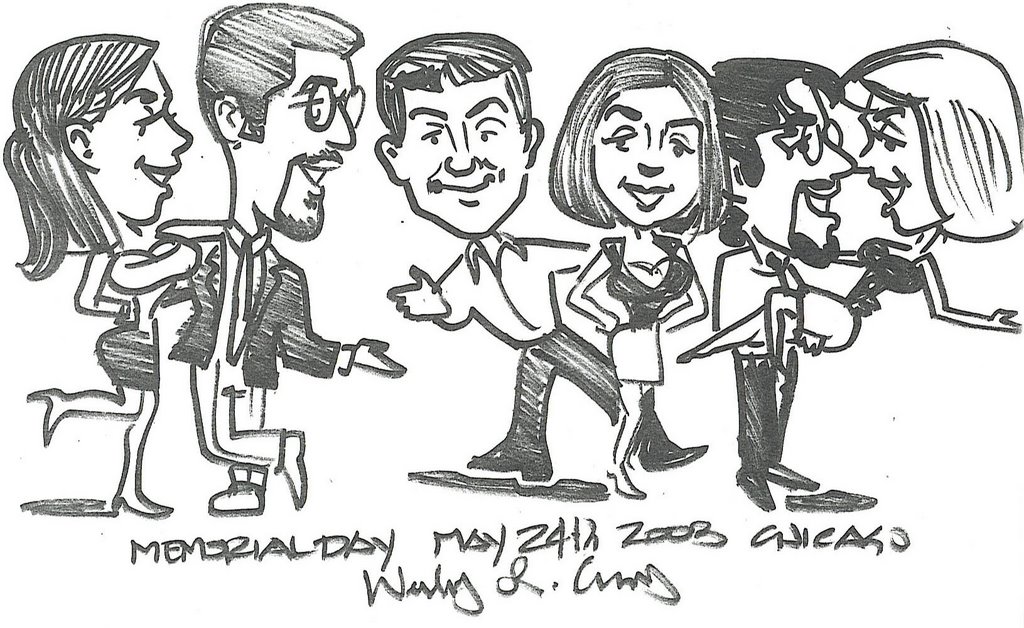
This is from a little over three years ago. Six of us were in a Chicago bar, and some artist drew this surreptitiously and brought it over. Of course, we bought it. In left to right order: Toad Press, dunkeys, Grendel, traca da broon, Vampiro, and Mrs. Vampiro. I think it's kind of disturbing just how well he captured us. Especially the waistlines. He got those just right.

7.14.2006

Free plants


As we are moving, we need to part with our leafy and spiny friends. Let me know if you'd like to come over and adopt one or more.

7.13.2006

Summer reading

Whatcha readin'? Most of my reading time is taken up with novel research stuff, but I've managed to slip in other stuff recently, too:

Valis. A romp through madness, paranoia, conspiracy, and healing riding a strange bucking bronco combination of autobiography and science fiction. Pretty funny, too. Reminded me of Vonnegut. Philip K. Dick's star has risen steadily since his death in 1982 because his stories tend to make good films.

Speak, Memory. About a quarter of the way through Nabokov's autobiography so far, and it's living up to the hype. Luscious sentences often containing breathtaking snark. I'd kill to write prose like this.

American Gods. I really wanted to love this, but it didn't do it for me. The style was too breezy and had stretches of slop and awkwardness, the protagonist was too remote and flat, and the detective story ending was laughable. Great idea, but it has to be all about the execution. I hear Anasazi Boys is better, but I dunno, now I am a tad wary of Gaiman. Someone defend this, because too many people I know liked it.

The Devil Is a Gentleman. Very good survey of modern American religious fringe movements, using William James as a touchstone.

Oxherding Tale. This novel was outstanding. Hilarious and heart-breaking and extremely well written. And short. A jewel. If you can imagine a comic novel about slavery ... oh, you can't? Seek it out. Read it. Made me want to read all of Johnson's works.

Red Earth, White Lies: Native Americans and the Myth of Scientific Fact. I don't swallow all of the author's assertions, but he does a formidable job of puncturing the myth of scientific impartiality and biaslessness. He retells the history of Indian settlement and white anthropology in America, uncovering systematic, often shocking racism. As it turns out, he was more right than wrong, as more and more scholarship agrees that no, the Indians did not exterminate the mammoths and other megafauna, and no, they didn't arrive only 11,000 years ago, and no, they were not poor stewards of the land. Perhaps the most fundamental bias has been that anthropologists simply don't take Indians' stories about their own origins seriously, preferring to weave their white, agenda-laden fantasies that take decades, in some cases a century or more, to dislodge.

American Indian Myths and Legends. Fantastic collection of rich, rich mythical stories. Better than the Bible.

7.06.2006

The lovely Paula Morris...

...will be reading from her lovely novel, Hibiscus Coast, at the lovely Prairie Lights bookstore, Monday, July 10th @ 7:00 p.m.

Lovely.

6.30.2006

Cristina Henriquez in the New Yorker again this week

In case you haven't cracked it open yet. This is number two for her, which is wonderful. Haven't had a chance to read it yet myself, but there is a long weekend beginning today.

6.29.2006

Adios, muchachos


Tomorrow morning I will point my car East and head out of town for the saltier and more donut-strewn environs of South Dartmouth, Massachusetts. My house is four blocks from the ocean. Feel free to visit.

I will miss Iowa City terribly.

6.27.2006

Consider the gonopodium

Editing a book about aquariums, in the fish-breeding chapter I encountered the fact that male fish "develop a stiff, rod-like appendage called a gonopodium," with which they impregnate the female. What a grand word the little fish gets for his member! (The female's organ is called the vent -- yawn.)

But gonopodium! Man alive. Why do mammals get the camparatively flabby, humiliating penis?

Anyway, the author goes on to mention that far more fry (baby fish) will be produced than you can possibly ever raise, and to use the extras as "feeders." She then goes on to cheerfully recommend inbreeding. Take some of your second-round fry, she says, and "breed the males with their grandmothers" in order to achieve whichever of her characteristics you're going for.

In my comments to the author, I mentioned the fact that some people might be put off to discover that their breeding program will actually turn into Soylent Green for fish. And I thought that she should really think about addressing the reader's likely alarm/distaste at being told to breed a fish with his grandmother. Regarding the latter issue, I wrote:
I don't see how you can let this incredible subject matter slide by as if it's ho-hum, as if it won't shock and even dismay the beginner!
To which she replied:
Why in the world would it shock a reader? It isn't like these fish are married and paying child support and know each other in family groups. Like these fish would not breed anyway if you tossed them in a tank?
I wrote:
Some people will throw the book at the wall right here. You have got to address the discomfort such a scheme will DEFINITELY produce in most beginning readers. Besides the opportunity for humor ... this is the richest motherlode I've seen in 14 years of editing!
She replied:
I don't think it is funny at all. You are making a big deal out of something fish do naturally, and that every hobbyist does. You think readers visualize fish calling for mates from the pet store? People are not that shut in. We are talking about cold-blooded fish, not humans.
After much back and forth, I wrote an example of the two disclaimers I'd like her to put in, and she accepted them and said to just put those in. First, I tackled death:
Beginning a fish breeding program brings with it some humane responsibility. Fish that you produce through breeding should, as they do in the wild, find their place in the biological ecosystem. Some species produce dozens or even hundreds of young. It's doubtful that you will want to keep every fish that your breeding pairs create. You should make every attempt to raise these fish, sell them, trade them, or give them away to good owners. If you think you cannot do these things, it may mean using excess fry to feed larger fish. Although this situation is found in nature, if you don't like the sound of you yourself doing it, then breeding is not for you.
And finally sex:
Inbreeding in mammals causes genetic defects, and many people find it a distasteful topic generally. However, in the fish world, it happens all the time. Sometimes survival depends on it. Fish inbreeding should not be thought of in the same light as for higher animals. However, it's possible that no amount of evidence or argument can get you over that hurdle. If that is the case, then inbreeding to produce new strains of fish is not for you.
She accepted this, but she still thinks I'm nuts. Am I?

6.21.2006

"one big fiesta for illegal aliens and homosexuals"

Those of you who regularly follow political blogs and/or read Frank Rich's column (good times) will already be familiar with the line. But have you heard the actual radio ad? Mariachi music is prominently involved. Spectacularly offensive. I wouldn't believe it was real if it weren't on the candidate's site.

6.17.2006

Slipstream?

What do Carol Emshwiller, George Saunders, Aimee Bender, Bruce Sterling, Ted Chiang, Jonathan Lethem, Kelly Link, and Michael Chabon have in common? They're all in Feeling Strange: The Slipstream Anthology. Anyone read this? It looks pretty intriguing to say the least. My wallet is itching. Thanks a lot, gwarbot, for leading me to this book.

Described as the "literature of cognitive dissonance and of strangeness triumphant," slipstream is supposed to come off as "hauntingly familiar and very, very strange." Bruce Sterling coined the term in an essay 17 years ago, which a Booklist review says meant "a kind of story that was neither sf nor fantasy, exactly, but that was showing up in all the places that sf and fantasy did; a kind of story that used sf and fantasy elements within otherwise realistic, or at least consistent, settings to provoke a feeling of strangeness or, better, feeling at home, strangely."

6.13.2006

J. C. Hallman interview: The Devil Is a Gentleman

Chris Hallman, Fiction class of 1991 and author of The Chess Artist, has published his second book: The Devil Is a Gentleman: Exploring America's Religious Fringe. The book is a vivid account of his personal experiences visiting eight different modern American religious groups, including The Church of Satan (make it your home page, folks), the Unarians (a UFO religion), Scientologists (I will not be linking to this one), Christian Wrestlers, American Athiests, Covenant of the Goddess, and the Monks of New Skete. Chris will be reading from his book at Prairie Lights July 21st.

Not content to simply report the insights gained by spending time with these organizations, Hallman deepens the whole kit & caboodle by weaving it all into an American zeitgeist uberstory via some terrific William James scholarship, channeling the father of American Philosophy and Psychology into pluralistic wonderment and teasing out numerous surprising parallels among ostensibly very different religious doctrines. This reader was up very late three nights in a row gobbling this stuff up. Well written and, it seems to me, of some importance, the book recounts a series of adventures into the spiritual bent of life now in our bizarre, pious empire.

See the San Francisco Chronicle review for another enthusiastic take on it. And without further ado:

EG: Can you summarize for us the basic tenets of William James's philosophy? What made him different among the intellectual giants of his day?

JCH: From a writer's point of view, James is probably most remarkable for being the origin of "stream of consciousness." This is James's metaphor for how the brain works -- he first conceived of it in 1880, and published it later in the decade. Obviously, this has had a big impact in how all kinds of narratives are executed. Gertrude Stein, for example, was James's student and worked with him on studies on automatic writing that probably influenced her later work.

The stream of consciousness filters down to all of literature. Stories weigh in on the same thing James was after -- the action of the mind. More generally, James is thought of as the father of the science of psychology, though he wouldn't have followed either of the paths it took after he died -- psychoanalysis and behaviorism. He was also the author of The Varieties of Religious Experience, which helped kick start the field of comparative religions and which I took as my model for The Devil is a Gentleman. And he helped found Pragmatism, which meant, in brief, celebrating variety even in something like truth.

EG: The world, including America, with the rise of fundamentalism and hardening of rigid religious doctrines, seems at present to be going in the opposite direction from William James and his pluralism and Pragmatism. What led you to write about William James now?

JCH: Coming to James was really kind of an accident. I was broke after my first book came out, looking for something to write about and trusting my curiosity. I heard about this UFO cult in California whose prophecy of nearly three decades was about to fail. I could barely afford to go to their first meetings after the prophecy fell apart. But I did go -- on the hope that it would be something that I could write about. That gamble paid off.

While I was out there I had the idea that the people I was visiting might capture something about what I remembered of William James. I bought Varieties again and took a look. It fit nicely, and I was on my way. James applies just as well now as he did a hundred years ago. The battle lines are pretty clear: the right, religion; the left, secularism. Ironically, James was a liberal who wanted to defend and justify religious experience. Not religious organization, but experience. So what he ultimately does, as a thinker, is attempt to heal that basic rift in the world. He applies not only to that goofy UFO group, but to everyone else as well.

EG: How did you choose which religious groups to visit? Did James' work itself lead you to investigate specific modern American religions, or were the James scholarship sections retrofitted to address different aspects of James's thought that seemed to emerge from your experiences with these groups?

JCH: I limited myself to groups that had a strong American component and came about in the 20th century. But those were just loose rules. The James influence went both ways -- sometimes the research led me to one group, other times it was the other way around. For example, the first scholarly paper I read about Scientology said that L. Ron Hubbard had once listed his sources for Dianetics: Descartes, Taoism, Korzybski ... and William James. I kept finding connections all over the place.

EG: In the chapter on Anton LaVey's Church of Satan, you describe them as "good guys," and I was struck by the fact that they were the only ones who didn't take themselves totally seriously. What did you make of the fact that here you have a religion which the adherents take with an apparent grain of salt? They seemed to be having the most fun. I'm thinking of their clothing and weaponry fashions and their heavily stylized rituals that appeared to be performed with a tiny bit of tongue-in-cheek.

JCH: What was interesting to me about the Church of Satan was that they took ritual very seriously even though they didn't believe in a literal deity. Their rituals had the power of satire, however you would describe that. Which accounts for the fun part. They weren't alone in being the good guys, though. The more benign groups, in general -- the witches, the druids, the monks of New Skete -- all found a way to celebrate individuality and creativity, and usually did so by leaving their beliefs abstract. In general, when beliefs, as in fundamentalism, become too literal, they head toward what James called "the wrong side of religion's account." Then they're capable of what even the Church of Satan would call "evil."

EG: You mention in the book that the Scientologists followed up with phone calls for six months after you left them. Have you heard their reaction to the book? Was your publisher nervous about including that chapter?

JCH: Well, I can still talk to you about them, so that's good. No reaction from Church officials, but Tom Cruise keeps leaving me voicemail. As to my publisher, nervous is probably not the right word. Let's just say they paid close attention to that chapter.

EG: After the Christian Wrestlers chapter, in several places you mention annoyance at the theatricality and entertainment component of their spectacles. What do you think James would have made of the rise of megachurches in the U.S.?

JCH: James hated everything big. The corporate sentiment ruined religion, he would have said, and did so long before anything like megachurches came along. He would have said the ceremonies, such as they are, were full of "second-hand automatisms." For James, religion was how one struggled with life. It was hard. He would have been much more interested in the Christian Wrestlers, whose shows at least pantomimed a struggle.

EG: The saddest group, to me, were the Atheists. Their numbers pitiful, their gathering cynical, disorganized, and argumentative. They seemed like lonely souls who weren't quite comfortable even with each other. You make the point that Atheism takes on some of the forms of religions. What made you include them in your book?

JCH: When you write about religion, you can't possibly be comprehensive. There's just too much there. All you can hope to be is representative. That's why I included atheism. Ultimately, even non-belief is a form of religion because it, too, is an unfalsifiable hypothesis. The American Atheists were struggling, it's true, because their leader had died and they were trying to keep the movement going. This made them similar to some of the other religions I was looking at, and gave them a certain poignancy as well.

EG: You visited the "dog monks," the Monks of New Skete. It's the last chapter, and you say in it that they were perhaps the group that you felt closest to. They are also the ones closest to being part of a long-established and organized religion (Eastern Orthodox). What is it about a religion that's in it for the long haul, compared to new groups that haven't had as long to perfect their rituals and beliefs, that was able to hold you better in its embrace?

JCH: Actually, it wasn't the age of New Skete or Orthodoxy that drew me at all. All religions try to give the sense that theirs is a long-standing tradition, with deep roots. For non-traditional systems, this often means harkening back to what can be discerned of pre-Christian religion. But really most of them -- and much of Christianity as it's practiced today -- are modern inventions.

I liked New Skete not because it was old, but because it didn't apply tradition uncritically. It celebrated individuality and creativity. They accepted the world as it stood, with all its variety, and in this way they embodied something central to James.

EG: How does the famous dog breeding and training program fit into the spiritual life of the monks?

JCH: The monks are generally pretty wary of being pigeonholed as dog monks. It's caused them some problems. Nevertheless, they did talk to me about how raising dogs informed their faith. A central characteristic, even a defining characteristic, of religion is that very often it's based on hierarchies, whether it's deacon-priest-bishop-cardinal-pope in Catholicism or the various stages of enlightenment leading to "clear" in Scientology. Often it's a kind of disappointing aspect of religion, at least to an outsider, because it seems to echo military ranks. The monks had an interesting take on this. The relationship between a man and a dog is hierarchical, and so is the relationship between man and God. A dog is most happy when it knows its place, when it rises as high as it can in the pack and finds its proper location -- with people, that place is a step further down the rung. This is roughly analogous to how people can understand their relationship with God. Less, but not necessarily subservient. That relationship helps to raise people up to what they can be. It's like leaven, one monk told me.

EG: Early on you mention William James's experiments with mind-altering substances. I understand James was a fan of nitrous oxide. Did he have religious experiences on it? He also tried mescaline, though I believe he claimed it had no effect on him. What was James's take on the role of altered consciousness in religion?

JCH: James did dabble. As a guy who was interested in varieties of consciousness, he sort of had to. But it's actually incorrect to say that he had religious experiences from drugs. He said repeatedly throughout his life that he never had a true religious experience, and the closest he came had nothing to do with substances of any kind. Ultimately, James's experimentation says more about his open-mindedness than it does about a link between drugs and religion.

EG: Your tone throughout the chapters is very even-handed and respectful, even though you remain skeptical and deliver to the reader what you think about each belief system. How did you arrive at your own perspective and point of view in the book? I mean, it must often have been tempting to ridicule or go for a big laugh at the expense of some of these people -- I'm thinking of the Unarians, the UFO cult. Yet you resist that and instead give the reader a kind of unvarnished and often touching and charming picture of these people and what they are doing.

JCH: I wanted to have it both ways. Some of these groups are pretty odd, you can't get around that. But there's something about the world, and about these belief systems, that makes them attractive to people -- they have adherents. I wanted to get at that, to portray these people in such a way that you began to get a sense of what was potentially attractive about them. Partly, too, it was a technical problem: Can you describe a Christian wrestling match in such a way that a sophisticated, skeptical reader came to care about the outcome?

EG: Have your own views of religion changed as a result of writing this book?

JCH: I became more Jamesian, more forgiving probably. The oddness of the world surprises me less.

EG: William and his literary brother were close their whole lives, though they had their differences. Do you see any influence of William's thinking on Henry's fiction?

JCH: Definitely. This brings us around full circle a bit. Henry was very interested in William's work, while William was just baffled by Henry's. So I think it's possible to measure William's influence on Henry, and there have been scholarly efforts in that vein. For Henry, I think, William was tapping into some of the basic irreconcilable ambiguities about existence. William wound up wanting to resolve those, but Henry, I think, chose to take them as simply a description of how the world worked, and wanted to employ them. It's interesting -- fiction, ironically, is the only place where we get certainty. If your husband tells you he loves you, you choose to believe him. But if a narrator tells us A loves B, you can take it to the bank.

Henry James begins to tinker around with this after his attempts at theatre failed miserably in the mid-1890s. He experiments with ambiguity to capture a part of reality and to create drama. It's not a stretch to say that this is another way in which William James, whose major work on psychology appeared in 1890, helped give momentum to the literature of the twentieth century.

EG: What are you working on now?

JCH: I'm writing an article about Pleistocene rewilding for Harper's magazine.

6.09.2006

A very interesting detention basin in Des Moines

Yes, Iowans really are this innocent... (via Rigorous Intuition). To paraphrase Sepka the Space Weasel, imagine future archaeologists finding something like this.

6.07.2006

Loose id dreaming

I've always had extremely complex, wild, epic dreams, and ever since I first read about lucid dreaming in the early '90s, I've been trying to control them. I've had limited success. Probably once a year I've managed to fly, sometimes only a few feet, sometimes up to a roof, and one memorable time I was on my bike flying around my parents' neighborhood in Indiana.

I spent the past five days in South Carolina at a family reunion on the coast. Early Sunday morning, with the sea wind bending palm spikes to scratch against my window, I had the most extraordinary dream, even by my standards. At some point I recognized the dreamworld and remembered that I could fly if I wanted to. I gathered my strength and concentrated and -- whoooom! -- flew straight up into the atmosphere! Where I spotted a menacing UFO directly above me, which in turn spotted me and swerved down to investigate.

(Flying saucers have been appearing in my dreams since I was a small child. I've seen them take my father away, I've watched them destroy San Francisco.)

It nosed at me, like a dog. Its surface looked like the graphics in the movie Tron, unfinished, conceptual. I had a weapon on me, some kind of rifle, and I dearly wanted to blow the damned thing away, but something told me there would be trouble if I did that, so I decided to escape. Remembering I was dreaming, I ... went to sleep! And there I was on my bed asleep, the UFO gone. So I got up and opened my door and found I was still dreaming and walked into my dream city.

My dream city is always the same city, a hodge-podge alien urban psychedelic weirdworld where I often travel by running along the rooftops. This time I found Tracy in a park and excitedly reported my new power. She asked me to show her, and I went flying straight up again -- careful to not go high enough to attract UFO attention. When I came down she asked me to teach her. We tried, and she levitated about three feet off the ground. A good start. Then we went shopping. We went to a rope store, one of those big, fancy, elaborate places where you buy ropes, you see. The shopkeeper was measuring out our rope, and from sheer exuberance I took one end of it, rose to the top of a tall spruce tree in his atrium, and tied it to the highest branch. When I came down the two of them were clapping.

Then Tracy and I went to a show at a vast theater complex. And then dinner. At dinner, she pulled out some magazines she had published, and she was on the cover of each of them. Except the women were different "hers," if you know what I mean. They each were her, but they were each a different version of her, and they all looked totally different. While I was oohing and ahhing, a fellow at a nearby table drifted over. Said he couldn't help but overhear, said he was a bigwig, and offered to be her agent. I saw that somehow he had managed to be standing over me, the crotch of his jeans a few inches over my head, in the posture of a dog peeing to mark his territory. Remembering I was dreaming, I bolted up and said to him: "Are you really trying to pee on me, or are you a symbol in a position to pee on me figuratively?" His smile fell, and he backed off a few steps. But then I felt mean, and out of guilt we listened as he continued his pitch. All we had to do, he said, was watch his multimedia presentation and then decide if we wanted him to be her agent or not. So we went into a booth and watched a screen.

The screen soon filled with extraordinary imagery, marvelous landscapes, mythic personas, a constantly changing spectacle that was truly impressive. But I started thinking, hey, this is my dream. Not his. I should control the imagery. So I pointed my finger and tried to burn a hole in the picture. Sure enough, like a film getting stuck and melting from the heat of the projector lamp, a small hole appeared in the fantastic show. I started making gestures, such as shamans are said to make in order to manipulate reality, and gradually I was able to tear the imagery apart, and even to crush some of the characters onscreen by squeezing my hands. Their heads popped, bloodily. It was immensely satisfying. Then we were back in the booth and we got up and left the building.

"Oh, but look at him now!" said Tracy when we got outside.

There was the guy who would be her agent, except now he was older and decrepit, shuffling along the street in ragged clothes, panhandling.

"Ah, jeez," I said. I felt terrible. "Did I do that to him? Okay, let's give him some money." I walked over to an ATM machine, inserted my card, and the screen showed me asleep again, as I had been when I escaped the UFO.

Only it really was me asleep on the bed this time, and I shot up, wide awake, my brain buzzing from dream chemicals, the insects outside screeching about their own dreams, it seemed to me. I grabbed my video recorder and began recording myself recounting the dream in as much detail as I could remember. In the middle of it, the video camera's battery died -- see? the machines don't want me to remember a thing like that -- so I quickly plugged it into the wall and resumed. When I was done, I walked down to the beach. It was 4:15 am.

I sat there looking at the ocean, feeling that I had crossed some kind of threshold, achieved a new measure of control in my dreams, and maybe even in my life. I felt more confident and joyous than I have in some time, and yet at peace, watching shiplights glimmer on the dim horizon. As in a video game, I had reached a new level, but I also knew that there were many other levels above that, and that the dreamworld is under some kind of military dictatorship, via those damned machines that terrorize from the sky.

I was also troubled to discover that the rule of morality of action, the karma law, is also in effect there. I had hurt that man, that character, whose job it seems was to show us his presentation, and when I destroyed it, I ruined his purpose, put him out on the street. I fired him. And then saw and felt the consequences of my actions. Are characters in dreams separate entities who share that reality? Are they forms melded in my subconscious? Does it matter?

I don't now how long I sat there in the sand. I felt extraordinarily alive and snug within my own purpose, my own expanding abilities in this short time on earth (I recently turned 40). I look forward to the new levels. I dare not hope that the abilities, as the shamans claim, eventually cross into the physical realm, but if they do, I guess what I'm doing now is practicing.

6.02.2006

In Case You Called . . .

For four days last week/weekend, the voicemail system for SBC (nee AT&T) went down . . . for the *entire* state of Nevada. Four days!

That's not even the weird part: I've just been doing Google searches to see what articles were written about this in the news . . . and I can't find a single one. Not in the local newspaper (a Gannett subsidiary), not on SBC's website, not in the Vegas papers, not CNN.com. Nothing.

Maybe I'm stupid ("maybe" is being kind), but isn't this news-worthy? The silence is surprising and even a little unsettling. Such a widespread technological failure followed by an entire lack of coverage is something I've never encountered before, not once in my life. Anyone else?

Four days! The whole state! Not one story!

5.26.2006

Cops investigate fiction writer, claim murder isn't appropriate subject for fiction

Friend of Earth Goat Saltwater Farmer alerts us to this incredible story of police with a confused notion of their duties in Florida. A short update is here. It's like something out of the old Soviet Union, and it would be scary if it weren't for the fact that it's basically campus cops trying to "play FBI." However, the fact that police anywhere somehow got the idea that they have the need and power to silence a writer of fiction is disturbing. As the article's author points out, if they're going to investigate every crime writer, they're "going to need a bigger budget."

5.25.2006

TLB on WSUI's TOI

The Lovely Becky will be on Talk of Iowa Live at the Java House tomorrow morning, Friday May 26, 10am AM 910. Presumably she will be discussing her well-received novel Icebergs.

5.22.2006

Leonard Cohen on Fresh Air

Airs at 11am on AM 910 in Iowa (rebroadcast at 8pm). The poet/singer has a new book of poems out, his first in 13 years.

5.17.2006

Random items

You can park almost anywhere now in our fair city. Most students = vamoosed or holed up studying. I rode my bike to the library and nearly went back for the car.

That cereal restaurant closed within months, as predicted.

Anyone seen the Everything Is Illuminated movie? Picked up its tag at That's Rentertainment. First impulse: take it up to the counter. Second impulse: pause thoughtfully, then doubtfully, then put it back and step away.

Peter Orner is reading tonight at Prairie Lights, 7pm. From Thisbe:

"peter orner ('98 workshop grad, author of "esther stories") will be reading from his novel "the second coming of mavala shikongo" tonight - wednesday the 17th - at prairie lights at 7. i really think it's a reading you shouldn't miss if you can manage to get there - the book is extraordinary, and peter's wonderful - truly one of my favorite writers."

Softball tonight, workshop-heavy Serenity Now vs. McClure Engineering Company. 9pm Hawkeye Softball Complex, Field 3.

Saturday night at The Mill: local stars Death Ships, Wisconsin's Wandering Sons, Drakkar Sauna, and SF's Two Gallants, about whose album Vice magazine says, "Take Kerouac with his up-to-late, thinking too much, missing-everything-and-needing-nothing amphetamine fueled rants, add it to foot pounding front porch anthems with swelling guitars and you've got an unbeatable album..." Doors 8pm. $7. With the students gone, we might even get a booth.

Anyone else read any William Golding besides Lord of the Flies? Currently being blown away by his novel The Inheritors.

Saw the first season of Battlestar Galactica via a friend's DVD. I recall Chad and I think Charlemagne praising it to the skies some time ago. Thanks for the hype -- it totally rocked. Character-driven sci-fi is pretty much the Holy Grail to me, and this delivered. Is Season 2 as good?

Finally, for the love of God, check out "Silent Library 3," via Trevor's Creekside "More Questions Than Answers" link (click on the video image). Why we don't have game shows like this I cannot fathom.

5.16.2006

Stanley Kunitz Dies at 100

I don't know how popular Kunitz is among the readership, but I thought he was a complete stud. Five years ago in Charlottesville, he gave (at 95) one of the most moving readings I've attended. Here's a timely bit from the Times obit:

In 1987, when Mr. Kunitz was 81, Gov. Mario M. Cuomo appointed him to a two-year term as the official New York State Poet. Writing for state occasions was not a requirement, but Mr. Kunitz would have been reluctant to in any case. "The poet is not in the service of the state," he said of his official post. "On the contrary, he defends the solitary conscience as opposed to the great power structure of the superstate."

To anyone looking for an entry point, I recommend this New and Selected collection. (I've been stealing from "The Wellfleet Whale" for years.)

5.11.2006

Best of the Last 25

The Times Book Review sent out ballots for the best American novel of the last 25 years and the results are in.

The list of judges is pretty impressive (and includes a few familiar names; I'd be curious to hear their choices).

5.09.2006

Let's Wiki the Workshop!

Hey gang. I've been using Wikipedia a lot lately, and if you haven't been paying attention, it's no longer a nerdy, crappy, dubious affair. It has now become sophisticated enough, big enough, and old enough to be a seriously interesting and valuable knowledge-acquisition tool, and I don't think it's hyperbole to say it may end up becoming one of the great info-dissemination landmarks in human history.

It will soon replace Google as a quick way to find mini-research facts ("What year was the lightbulb invented?"), but more than that, it's going to eventually be an indispensible tool in any and every kind of research -- far more than print encyclopedias ever were. If you hang out with it for a few days (as a lot of you probably already have), I think you'll get a sense of that.

Anyway, I was thinking it'd be a fun project if we put our collective megalith brain power, writing skills, and tendentious tendencies to work and cooperate on getting the Iowa Writers' Workshop article in better shape. As it is now, there's a short intro followed by an interminable list of former faculty and "notable graduates". I think that stuff is relevant, but there's a lot that's more relevant and interesting, and much of it is known by us.

I realize there might be some tinge of arrogance or partisanship if we IWW grads write 'the book' on the Workshop ourselves, but it really doesn't matter. What matters as far as Wikipedia is concerned is that we get as much of the relevant, neutral facts and history on there as we can, and people can argue late about what parts are hometown dogma. In one sense, we're experts on the subject -- and together I think we could put together a pretty fine article for cyber-posterity.

The side bonus is that people who don't have much exposure to Wikipedia can get familiar with it. As I alluded to earlier, it's not going to be a nerdy subculture much longer. It's going to be a fundamental life resource. ISYN. So gettin' hip to it can't hurt.

Brief primer for you ignints: 'wiki' was conceived as a technology in the spirit of Open Source, and allowed communities to freely collaborate on the creation and editing of web pages. Early wiki stuff was cool because you could live-edit some web page somewhere without messing around with its HTML. Groups used it to brainstorm, to plan projects, to keep lists, etc. You just pressed the EDIT button on the page and typed stuff into an interface not unlike the one this blog uses.

Wikipedia is the same way. Anyone can edit ANY page on the site at ANY time, even anonymous users, and even the most frequently viewed and important pages. There is a very smart system that keeps track of every edit the page gets, so that, for instance, if a vandal deleted the entirety of the U.S. History article, the next person could just revert it to the previous version. You can see the entire history of edits of a given page at any time, scrolling through it one-by-one if you want to. Each edit shows who made it, too, unless it was anonymous, in which case the editor's IP address is shown.

Each article (and there are 1.1 million of them and counting) also has a 'Talk' page, where users can discuss and/or debate and/or argue about which edits are good and which suck. This democratic and egalitarian approach turns out to result in some very high-quality articles, and for that reason is pretty amazing considering the whole thing runs on donated time.

Anyway, there's a lot more to it than that. If you want a real intro, go here.

Cool, lemme know whatchall think.

5.06.2006

The Kids are Alright

TRG and Luka were bounding around the yard and doing well yesterday.

5.05.2006

I've Always Wanted to be a Mat

As some of you know, Paul Westerberg gave me probably the most important and thrilling kiss of my young teenage life -- so I'm pretty psyched about this one, from Pitchfork (plus the mention of Rome made me think of Chad, sweet dear too-far away, Chaddy McChad):

"It's the first new Replacements song in 16 years, but you probably missed its world premiere on knucklehead jock/Mats fanatic Jim Rome's radio show yesterday. The odd unveiling followed their fuck-it-all, bittersweet career trajectory perfectly with Paul Westerberg blowing-off an accompanying live interview with Tommy Stinson; these guys can't win. As the faithful bassist stumbled through the same questions he's spent 16 years trying to erase (answering the inevitable reunion tour query with an exasperated "I don't know"), he noticeably perked up when talk turned away from the Mats' murky future to Los Angeles basketball. Original members Westerberg, Stinson, and Chris Mars (who contributes back-up vocals)-- along with hired stickman Josh Freese-- recorded two new tracks late last year as part of an upcoming greatest hits package, but hopes for a full-fledged Mats reunion seem foolhardy, as this song subtly attests.
Rather than a new beginning, "Message to the Boys" works best as loyal farewell. Reminiscent of three-chord struts like Tim's "Hold My Life" and "Little Mascara", this is vintage mid-era Mats-- in between the early gutter punk and the late maudlin mopes. Westerberg's booze-bard lyrics are characteristic to the point of self-mythological as he begins, "Well, I met her in a bar/ Like I always say." His lost love's doomed existence as a roaming runaway who's missed but not forgotten delicately doubles as a keen Replacements allegory. "Yeah, I miss her and her voice," sings Westerberg. The Mats are dead. Long live the Mats."

5.03.2006

Ireland and The Netherlands

are where we'll be for the next week. Expect another Euro-centric freedom-hating diatribe from an Internets cafe at some point. Otherwise, behave yourselves. Tot ziens, en let op, gezelligheid, er komen wij.

4.30.2006

Bush forced to listen to everything you ever dreamed of saying to him, only you wouldn't have been so clever or funny or brave

Thanks to Stephen Colbert. Holy mother of God! The man has titanium cajones. Read the transcript of his monologue at the White House Correspondent's Dinner, and you will feel better than you have all year. See the video here.

4.28.2006

Now, of course, I don't know what it looked like in Latin

I just read today's Earth Goat tagline: "Anyone who has got a book collection and a garden wants for nothing." Has got? Did Cicero really write that? I think he should give his translator a beyond-the-grave smackdown.

You think you're in better shape than me?

You're undoubtedly right. So run RiverRun. This Sunday @ 9:00 a.m. at the IMU. You can be a complete wuss like me and do the 5K or be bold and energetic like traca de broon (aka Ms. Grendel) and do the 10K.

You can register up through the morning of the race. Proceeds benefit Extend the Dream Foundation (Uptown Bill's).

Did I mention T-shirts and free food?

Little, Brown pulls plug on copy/paste novel

"Unintentional and unconscious" use of 40-some passages just doesn't cut the mustard, I guess.

4.27.2006

The Morning After

TLB did a fabulous job at her reading - you would never have guessed that it was her first. She handled the Q&A adeptly, too. There was a very large crowd, including, for about two minutes, the Man Who Used to Wear a Seersucker Suit but Now Does Not. He was sitting next to bR, and about two minutes into the reading, the Man got up and left. As I was departing, however, I noticed that the Man was sitting back in that reading nook on the second floor of Prairie Lights. We can only deduce from this information that he wanted to hear the reading, but needed to get away from bR. Perhaps the Man was intimidated.

4.25.2006

Why are we in Afghanistan and Iraq and, soon, Iran?

Here is a persuasive shortish paper outlining the probable real reasons, also meanwhile explaining why our McEconomy, such as it is, is still propped up. In a country with a media that wasn't dominated by corporate interests, articles like this would be in the paper. Get them on the Web while you can! A snippet:
Oil can be bought from OPEC only if you have dollars. Non-oil producing countries, such as most underdeveloped countries and Japan, first have to sell their goods to earn dollars with which they can purchase oil. If they cannot earn enough dollars, then they have to borrow dollars from the WB/IMF, which have to be paid back, with interest, in dollars. This creates a great demand for dollars outside the U.S. In contrast, the U.S. only has to print dollar bills in exchange for goods. Even for its own oil imports, the U.S. can print dollar bills without exporting or selling its goods. For instance, in 2003 the current U.S. account deficit and external debt has been running at more than $500 billion. Put in simple terms, the U.S. will receive $500 billion more in goods and services from other countries than it will provide them. The imported goods are paid by printing dollar bills, i.e., "fiat" dollars.

Double Take

For those who may have seen the new Dunkin' Donuts ad campaign on tv or at Slate, an alternate version, from James Tate:

"A New Lifestyle"

People in this town drink too much
coffee. They're jumpy all the time. You
see them drinking out of their big plastic
mugs while they're driving. They cut in
front of you, they steal your parking places.
Teenagers in the cemeteries knocking over
tombstones are slurping cafe au lait.
Recycling men hanging onto their trucks are
sipping espresso. Dogcatchers running down
the street with their nets are savoring
their cups of mocha java. The holdup man
entering a convenience store first pours
himself a nice warm cup of coffee. Down
the funeral parlor driveway a boy on a
skateboard is spilling his. They're so
serious about their coffee, it's all they
can think about, nothing else matters.
Everyone's wide awake but looks incredibly
tired.
-from Memoir of the Hawk (2001)

4.24.2006

TLB's Debut

TLB will be reading from her fabulous novel Icebergs on Weds., 4/26, at 7pm, chez Prairie Lights. Party to follow at the R-H Compound. Be there!

Verb Fiction Contest

Laurel Snyder wants you to
SUBMIT to the FIRST ANNUAL VERB FICTION CONTEST!

Any unpublished story (up to 5,000 words) is eligible
Winner will receive $1000.00 and publication* in VERB!!
All finalists will be considered for publication.
Submissions must be postmarked on or before July 1.
Manuscripts will not be returned.
Winners will be announced in October, 2006.

For each entry, submit the following:
  • A check for $15, made payable to VERB.
  • Two cover sheets. The first should include only the title of your story.
  • The second should include the title of the work, your name, phone number, mailing address, and email.
  • A self-addressed stamped envelope.
OR SUBMIT ONLINE @ VERB.ORG

Mail to:
VERB FICTION CONTEST
PO Box 2684
Decatur, GA 30031

*VERB is the first AUDIOQUARTERLY, which means that you'll be recording your story for distribution through AUDIBLE.com, and to subscribers on a CD. If you would prefer, an actor may record in your stead. Past contributors include Robert Olen Butler, Stuart Dybek, Peter Case, Julianna Baggott, Ha Jin, and many others...

4.21.2006

d'Ambrosio question

Did you go to the d'Ambrosio lecture a few weeks back -- or did you have him as a teacher? If so, would you be willing to be part of an article about him? Email earthgoat@gmail.com if interested.

4.20.2006

Recent links

Over the past few months, I've been adding links to the right-hand side of this site. Here is a run-down of some that might interest you, in case you never stray over there.

Bob Hillman (not really ever called Mr. SER but I would like the honor of being forgiven for doing so here, once) is playing tonight at George's after the Saunders reading. His site has a lot of info about him and his new album If You Lived Here, You'd Be Home. Bring extra money to George's tonight because when you hear him you'll want to buy the disc, which includes a song called "The Red Light District of Iowa City."

Frequent commenter Trevor Jackson's blog Creekside Review is a treasure trove of information on new bands and offers loads of mp3 files for download (see especially Special Features on the left-hand side). I hold him directly responsible for my need to finally buy an iPod, and for helping keep it filled with phenomenal new music.

Midwestern Deadbeat is chronicling the trials and tribulations of Squig & parents; Iowadrift relates the adventures of Rabbit, Urplet, and TTD from Mom's POV; Illiterati is a slice of TLB's life as a recently published novelist. All 2003/04 classmates.

David Byrne's Journal is fun to read, especially if you pretend it's being spoken by his voice as you do so. He updates it once a week or so, describing his thoughts on things like Mayan vacations, Bush's leadership, and a Neko Case concert where he lost his lens cap.

Rigorous Intuition is the place to go when you want to wonder at Jeff Wells's courage and ability to connect, think outside the box, and ponder High Weirdness and Deep Politics -- without quite ever going over the edge.

Seed Magazine provides some of the hippest science on the Web.

Reason Magazine somehow does the impossible. It analyzes political issues from a nonpartisan perspective.

Slashdot has been around forever and remains an amazing site about everything, written by semi-genius geeks.

Something Awful is something pretty funny. Neglect not its forums.

If it didn't seem to know me so well ...

Get your gangsta name -- mine was "Two Time Scratchy Nutz."

It's like they have cameras in my house!

http://gangstaname.com/

4.19.2006

OHHH MYYY GODD!!

May 4, 2006 (Thursday) -- Paradise City, the nationally touring Guns and Roses tribute band, is playing at the Yacht Club. I want to get tickets early.

Who's with me!?!?!?!!

4.18.2006

Cool Stuff, or maybe not so cool

A book at the library caught my eye: Cool Stuff and How It Works (by Woodford, Collins, Witchalls, Morgan, Flint). Flipping through it, I learned the rudiments of how iPods, pet translators, MRIs, fire suits, Tholos pods, and bionic feet work. Then I ran across the following exposition on pages 44-45. Imagine this being read in a futuristic, soothing, omnicultural, everything-is-going-exactly-as-we-planned kind of voice:
In the next decade, most electronic devices will become connected to the World Wide Web by high-bandwidth fiber optics. When you are on the move, computers built into your clothing will be able to link with navigational satellite systems to tell you your precise location and enable you to download information on local services.

Invisible sensors embedded in public space, from parking ramps to art galleries, will recognize and respond to your presence. These areas, called "intelligent environments," will be able to provide information according to your needs and preferences, such as showing the way to a parking space or directing you to an artwork that particularly interests you. The technology may also be used to sell products: as you pass by a digital billboard, the display might change automatically to show items tailored to your own lifestyle.

Sensors will play a central role in the development of "affective computing." This technology will enable computers to gauge your moods and respond to them. Cars will be able to detect when you are stressed or angry and slow down automatically to reduce the risk of accidents. Chairs will know when you are bored, tired, or frustrated and shift their position to make you feel more relaxed or alert. Phones will be able to register whether you are happy or sad while you are speaking and create emotions or color feedback patters to communicate this to the person on the other end of the line.

Computer technologies will bring new benefits, and past obstacles will disappear. For example, instant translation technology will allow you to speak English into your cell phone and be heard in Japanese by the person you are calling in Tokyo. On the other hand, with our cell phones and computers constantly communicating with one another, satellites surveying our positions from space, and sensors monitoring us on the ground, privacy may become impossible. Some people fear that this problem outweighs the benefits that better communications will bring. But the information age is here to stay, and it will continue to make the world feel like a smaller place, and to be one in which everyone takes part in the free exchange of ideas and information.
I can't begin to express how disturbing such a future sounds to me (mostly because it took so long to type I have to go to the gym now), nor how chilling the tone of such alarming predictions has become. It makes me want to buy acreage in Montana or Greece and raise goats and vegetables.

4.15.2006

We're OK

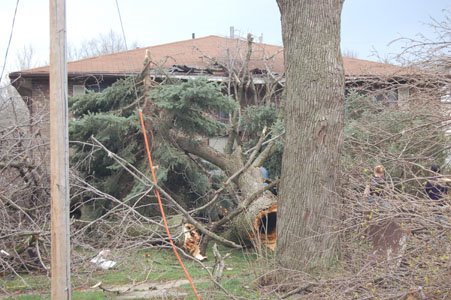
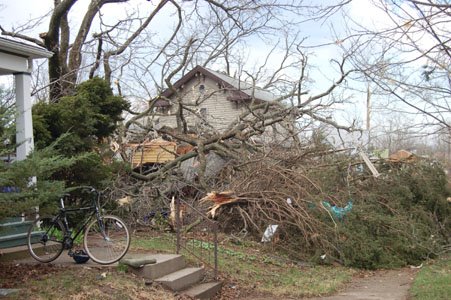
Here's a little taste of what we saw when we woke up Friday morning:


What you're looking at is the place where our garage landed.

You can find the rest of the story at Illiterati. Thanks for your good wishes, emails and calls.

4.14.2006

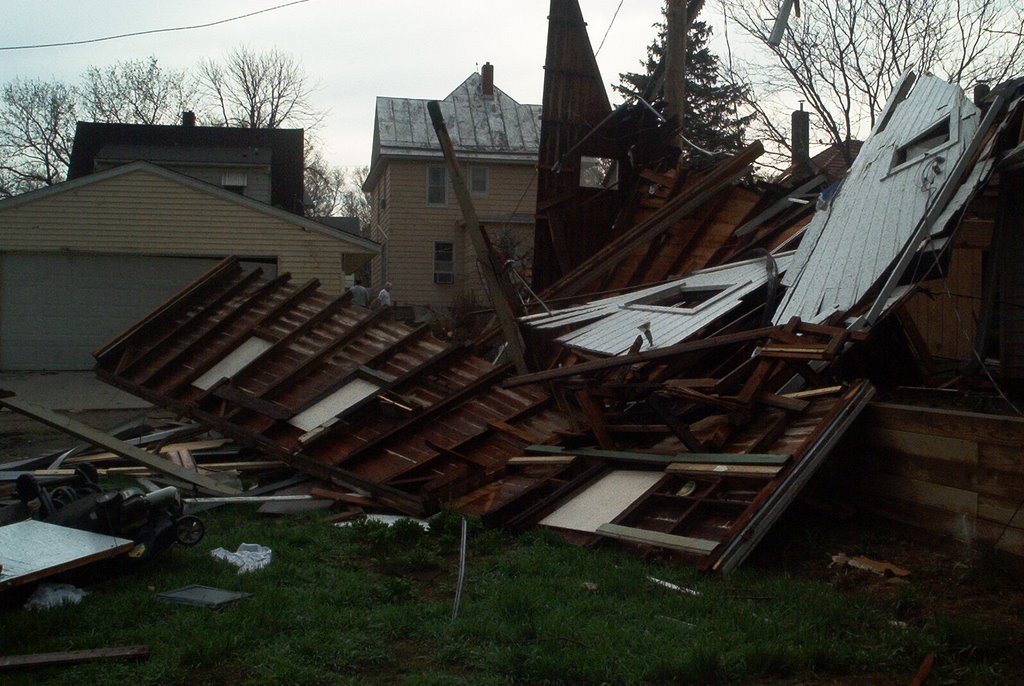
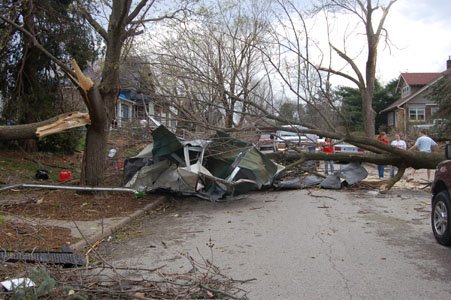
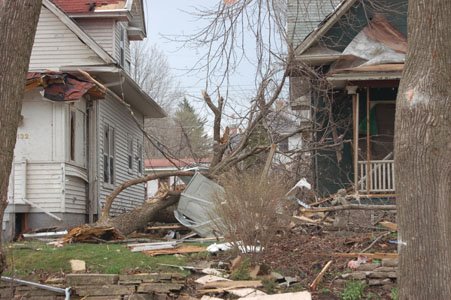
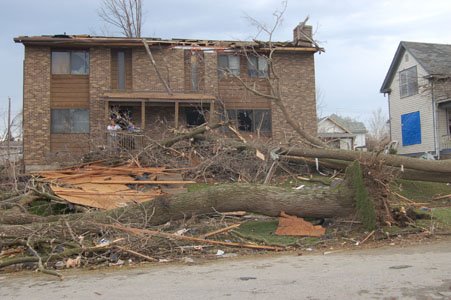
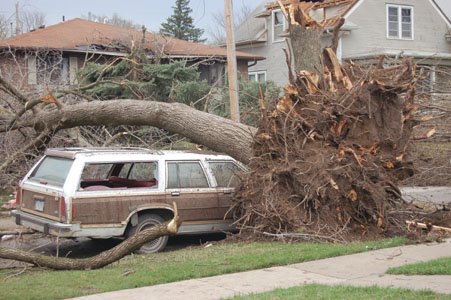
Wreckage

This is all two blocks from Earth Goat headquarters, on TLB and Brando's street.


Tornado stories


Iowa City was struck last night by a bad, bad storm. Tracy and I had broken our New Rule and gone out for a beer during the week to celebrate her completion of a big work milestone. So we were at George's when Severe Thunderstorm Warnings came on TV, and we went outside to check things out along with other patrons. The rain began coming down in sheets filled with hail the size of marbles.

Then a Tornado Warning was issued, and by God if we didn't see, looking southwest from George's doorway, an enormous pale grey funnel cloud plowing right through downtown and advancing northeast, with flying debris clearly visible spinning around it. (What killed me were other people standing around looking at the thing and saying it wasn't a tornado! "It's some kind of weird cloud." And that Press-Citizen story also for some reason refrains from calling a spade a spade.) The friggin' tornado seemed to be coming right for us. Jenny the bartender stuck her head out, took one look at the thing, and ordered us all into the basement.

Where she offered free drinks from cases of beer stacked around. Within ten minutes, all seemed clear, and we all climbed once again to the surface, blinking in wonder at our new, quiet Oz of a town. We biked home, where we discovered that the power was out and there was a lot of debris in our yard, including an 8-foot piece of someone else's roof. Our street was blocked off due to fallen trees and powerlines coiled all over the place, and traffic was backed up for a couple blocks. bR called to see if we were okay and said they were fine.

Later, TLB and Brando stopped by with stories of their own that they might talk about in a comment or on their own blogs. We all tramped off then to look at their street, which was a disaster zone. On the way, some guys offered us beers and a chance to see the damage to their place. Their porch was battered, a board had pierced their kitchen wall from the outside, and one guy led us out the back door to consider his truck, smashed nearly flat by a huge tree.

I plan to post some pictures later. Classes canceled today, library closed. Much of downtown still without power.

4.13.2006

Why I Enjoy Being A Lawyer from Texas

As an Easter gift to you, here is a deposition video from Joe Jamail, Texas’s most prominent attorney.

For those of you not from Texas, practically everything at the University of Texas is named after Jamail (who, according to most accounts, was a C student). He made his name with the Texaco v. Pennzoil case, where he won an $11 billion dollar judgment by basically making fun of New York.

From an online book review: “The flamboyant Jamail (who collected a $400 million fee for his work, of which $50 million reportedly has been given to charities) was known previously, the author tells us, for such feats as convincing a jury that the City of Houston was negligent for planting a tree that his client ran into while drunk. Here, he won the verdict for his client, in part, by exploiting that shopworn cliché of trial practice - the local good of boys versus the big city pinstripes. Is an oral agreement in principle a binding contract? Metaphorically shrugging, Mr. Jamail told the jury, "Sure looks like a deal to me." It worked like a charm.”

In the video, Jamail is the arm off to the right trying to take the deposition.

4.12.2006

Repent now! The end (of literature) is near!

My first thought: kill me now.
My second thought: there is still a good market for ghostwriters.
My third thought: kill me now.

Create your own comic strip online

As if you needed another way to waste your time. Here is the one I made -- it's not very good, but it is either archetypal or cliche, depending on your mood.

4.11.2006

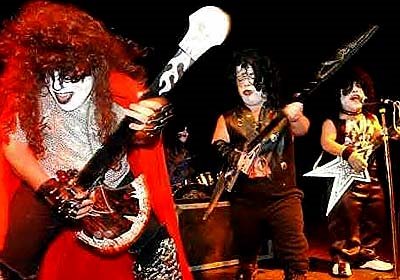
MiniKiss vs. Tiny Kiss


Back to important stuff, like the battle over who owns the "concept" of the little-person Kiss tribute band.

Ambition

There is an interesting piece in the NYT asking why literary writers have stopped writing about ambition, the desire to move up, get ahead, succeed. It's actually an interesting point, but I think the author's own answer to the question is absurd. Why did we stop writing about Horatio Alger? Is it cynicism that one has little control over one's success? Is it an embarrassment of some kind? And didn't the Goats or the Babies once have a thread about the lack of novels about poor people? Perhaps the issues are related.

4.10.2006

Noam Friggin' Chomsky tonight

7pm, Englert Theater, free. First come first served, doors open at 6.

“Chomsky is a global phenomenon . . . perhaps the most widely read voice on foreign policy on the planet.” — New York Times Book Review

"The number one public intellectual." -- Foreign Policy

"America's most useful citizen." -- Boston Globe

"It is possible that if the United States goes the way of nineteenth-century Britain, Chomsky's interpretation will be the standard among historians a hundred years from now." -- New Yorker

"Without question, the most devious, the most dishonest and -- in this hour of his nation’s grave crisis – the most treacherous intellect in America belongs to MIT professor Noam Chomsky." -- David Horowitz

Let's face it, the picture we were all hoping for

The crowning glory.

4.08.2006

Franken vs. Coulter

In case you missed this... Al Franken's skewerous opening statement in a debate with Ann Coulter.

4.07.2006

Dan Brown wins plagiarism lawsuit

This is a key ruling for fiction writers and for freedom of speech and of the press. Imagine if he had lost, what that would mean in terms of doing historical research for a novel or spinning a scenario based on events that may or may not have happened in the real world. My own novel borrows ideas from literally dozens of nonfiction authors, all of whom I admire and would never want to hurt financially or otherwise. It's what is done with the ideas, I think, that should count, as long as credit is given where due. I am breathing much easier this morning.

4.06.2006

Coming Together

Now that I have your attention, please join me in congratulating our own cek on the release of her story collection Come Together, Fall Apart. Great job, Cristina!

4.05.2006

Huck and Jim discuss Rep. McKinney

Some character named Wilbur on DailyKOS has put up a fairly funny diary called "Omigod, the Nigra Woman's outta Control!" in which Huck and Jim watch the "sat-a-lights dish" on their raft and try and figure out what's happening with this "nigra woman" who hit a policeman. I guess I've seen better Huck impersonations, but never one so timely. A snippet:

Jim shrugged. "Cynthia's a Nigra, already got some problems. But lookie here, any momma of a Nigra is going to tell her little girl, some white man grab you - then girl you got two choices. You hit back right then - or you gonna have nine pounds coffee with cream in jus' nine months - that's God's word."

Well this was too much, even from Jim. "You think this Cynthia, she scared she going to have a baby from this policeman?"

Jim shook his head like I don't know nothing. "It gets to be what they call in - grained." He pointed to his head. "Sometimes you got to fear everything, cause when you don't you jus' don't know what to fear."

4.03.2006

Iceberg? Is that Jewish?

The latest, greatest first fiction from the Class of '03, Icebergs, is in stores tomorrow. Wahooooooo! for TLB.

Kevin Brockmeier Interview

After thoroughly impressing many an Earthgoat reader at Prairie Lights, Kevin Brockmeier headed south to Charlottesville for the Virginia Festival of the Book, which can be awkwardly viewed this week on C-SPAN. Following a "Strange Worlds" panel, he graciously agreed to be interviewed, the results of which appear here in an EARTHGOAT EXCLUSIVE! Kevin Brockmeier already is the author of two novels, two children's books, and a story collection. (At this rate, he'll bury Joyce Carol Oates.)

EG: Your new novel, The Brief History of the Dead, creates a city in the afterlife that doesn't have a worldly counterpart, though its particulars are largely recognizable. How do you navigate the tension between realism and the fantastic?

KB: I suppose I navigate the tension between the realistic and the fantastic largely by failing to recognize it, though I don't know whether I would call this a working method or a blind spot. Typically, when I sit down to write, any fantasy I turn my mind to very quickly begins to seem stitched through with realism. And, conversely, the reality of the world I can see outside my window---I'm talking about the world of human behavior, as well as the world of physical objects---begins to seem touched with fantasy. The disadvantage of this way of perceiving the world is that no matter what kind of story I've set out to tell, somebody somewhere has always been convinced that my narrator was simply making the whole thing up. It does seem to me, though, that the simple act of using language necessarily imposes a layer of fantasy between the real world and the narrative world, since even the most realistic detail has to be re-imagined before you can set it down on the page.

EG: Are there aspects of realism from which you rarely, if ever, wander?

KB: There's a writer named Lucius Shepard whose work I enjoy. He complains about what he calls the "elf-dragon-unicorn axis" in fantasy. I don't believe I've ever written anything that would fall neatly along that particular axis (though I sometimes appreciate books that do: The Last Unicorn by Peter S. Beagle comes to mind). More broadly, I always attempt to create characters whose emotions and instincts and sense of what it means to be alive correspond to those of real human beings as I see them.

EG: I have a lot of admiration for your figurative language. I remember distinctly from The New Yorker excerpt the man who describes his death by "making a gesture like falling confetti with his fingertips." How important do you consider metaphors, relative to other writers' tools, to your fiction?

KB: They're extremely important to me, but this is mainly a function of how my mind works when it turns to sentence-making rather than the result of any particular aesthetic program. I strive for a certain level of imaginative precision when I write (as opposed, say, to scientific precision), and the metaphors that present themselves to me frequently seem the most interesting way to achieve that. You should picture me allowing my fingers to flutter through the air while I try to figure out how on earth to describe such a gesture.

Sometimes metaphors are important to my fiction in an architectural sense, as well. I don't know that this sort of thing is necessarily plain to most readers, but often it is a controlling metaphor that most sharply informs how I decide to put a story together. In the first chapter of The Brief History of the Dead, for example, I had in mind the image (or the metaphor) of one thing spreading open inside another---doors within doors within doors, most of which never close. It was that image, more than anything else, that helped me give shape to the story.

EG: Your second children's book, Grooves, was just released. Did your desire to write children's fiction grow out of your desire to write adult fiction? How do children's and adult projects differ for you in terms of process?

KB: I began writing children's fiction for two reasons: First of all, I began to read children's fiction again---including many of the books I myself loved as a child, but also many that I had failed to notice back then and many that weren't yet written---and I found that the best of them offered me as much aesthetic pleasure as the adult fiction I was reading. Second, when I was in college, I used to teach at a nursery school, where I would make up stories for the children in my class, and I wanted to find a way of continuing to tell stories to those particular children, all of whom were in the later years of elementary school by that time and capable of reading for themselves.

I've found that my children's books are more conversational in tone than my adult books, and a lot more jokey. I want them to read as though you're listening to a child who's simply telling you his story as it occurs to him, along with anything else that happens to cross his mind. Also, it's my notion that most narratives move forward in one of two ways: either sentence by sentence or paragraph by paragraph. In my adult fiction, the unit of meaning I tend to rely on is the sentence, whereas in my children's fiction it's the paragraph. I'm not sure why this should be, but it feels natural to me.

EG: Are there writers of adult fiction whose children's fiction you admire? Alternatively, are there writers of adult fiction who don't take their children's work seriously enough?

KB: I know that many writers have recently begun working in both disciplines---Michael Chabon, Louise Erdrich, Isabelle Allende, and Edwidge Danticat come to mind---but as much as I appreciate the adult work of some of these writers, I'm afraid I just haven't read most of their children's fiction. Neil Gaiman is a writer who does both, and while, honestly, I think of his Sandman comics as his best work, I would say that the prose fiction he writes for children is every bit as good as the prose fiction he writes for adults. My friend Jeremy Jackson writes novels under his own name and young adult fiction under a pseudonym, both of which seem to me to be books of considerable enterprise and sensitivity.

What I can tell you is that most of the children's writers I admire---I'll name Daniel Pinkwater, Philip Pullman, Franny Billingsley, Jonathon Scott Fuqua, and Madeleine L'Engle, for starters---are writers I admire as an adult reader and not just as some sort of jerry-built child reader I've imaginatively reconstructed inside my own head. These are all writers whose prose is every bit as careful and whose characters are every bit as rich as those of the adult authors I enjoy.

EG: How important is children's fiction to developing readers of adult literary fiction?

KB: I'm tempted to say, "Very," simply because I myself write in both forms, but when I look back over the reading I actually did as a child, I realize that it was mostly made up of comic books, along with works of fantasy and science fiction and mysteries and film novelizations and various paraliterary genres like joke books and catalogs of do-it-yourself science experiments, all of which were at least ostensibly intended for an adult audience. I would suggest, then, that what's important is encouraging in children the habit of reading and taking pleasure in language and stories, no matter what their provenance.

EG: It seems fewer writers today believe literary fiction and genre fiction to be mutually exclusive. How meaningful do you consider the distinction? What genre fiction, if any, do you draw from and what genre fiction do you not read?

KB: I tend to think that genre distinctions fall apart pretty quickly as soon as you begin looking at fiction of real accomplishment. Cosmicomics by Italo Calvino is published as literary fiction and The Man Who Fell to Earth by Walter Tevis (a Workshop graduate, by the way, and probably the one whose work means the most to me personally) is published as science fiction, but you could easily reverse their positions on the bookshelf, and, at any rate, both are written with so much potency and exactitude and complex human feeling that the difference hardly matters. I read widely in fantasy and science fiction and more narrowly in mystery and suspense. I rarely read horror---not out of any disdain for the possibilities of the genre, but for the same reason I never set foot on a carnival ride: because I don't enjoy terrifying myself. And I have the (perhaps ill-informed) impression that all the truly artful westerns and romance novels are published as mainstream fiction, so I've mostly ignored those genres, aside from one Harlequin Temptation Romance called When Tomorrow Comes that I read after a friend at the Workshop gave it to me because the book's villain was named Brockmeier, which afforded the protagonist the opportunity to say things like, "I've lost patience with you, Brockmeier. Your interfering has gone too damned far!"

EG: A recent novel that jumps across different genres that earned a lot of discussion here is David Mitchell's Cloud Atlas. Any thoughts on that book? Have you read anything recent that blew you away?

KB: I enjoyed and admired both Cloud Atlas and Ghostwritten, the only David Mitchell novels I've read so far, but somehow I was never able to feel the heart beating through the pages of his books, and I suspect that he's one of those writers I'm doomed to appreciate without ever truly loving. Still, I'm sure I'll keep reading his work.

The two best books I've read in the past month have been a collection of interviews with Gabriel Garcia Marquez called, unsurprisingly, Conversations with Gabriel Garcia Marquez and a first novel by a Workshop graduate named Justin Tussing called The Best People in the World, the prose in which is quite extraordinarily beautiful, every sentence sharpened to the finest of points.

I'm in the habit of keeping and periodically revisiting a list of my fifty favorite books, which I'll append to the bottom of this interview in case you want to include it. (Editor's Note: I did.)

EG: Many readers of this site attended the Iowa Writers' Workshop after you graduated. Was anyone there particularly influential to your development?

KB: I studied with Marilynne Robinson, Frank Conroy, Jim McPherson, and Judith Grossman while I was at Iowa. I appreciated all of them, but Marilynne and Frank were the ones whose counsel meant the most to me. Beyond that, the other students who were at the Workshop from 1995 to 1997 were extraordinarily important to me. I knew that every story I wrote would face a sensitive and demanding audience, and in many ways those same people remain the audience I keep in mind when I write today. For instance, I still imagine the effect a title might have as it stares up from those stacks of manuscripts on the shelf by the front office. Every so often I'll even think through the whole catalog of stories I've written and try to determine which eight would have made the ideal workshop submissions while I was there. This is absurd, I know, but at least I can say that when I'm finally able to travel back in time with all the writing I've done since I graduated, I'll be well prepared.

(I also have a great deal of affection for Connie Brothers.)

EG: What was it like coming back to teach? Did the city or program seem very different?

KB: The city has a few more parking garages than it did when I was a student, and the winters a little less snow, and the Workshop itself has moved from the English-Philosophy Building to the Dey House---but other than that it's much the same. Prairie Lights is still there, and so is Paul Ingram, and so is Julie Englander. The Hamburg Inn is still there, along with the Cottage and the Java House. To be honest, I found the prospect of coming back to teach at Iowa a bit intimidating. I had never taught at the graduate level before---or, for that matter, in any setting where I couldn't presume myself to be the sole authority on whatever topic we happened to be discussing---and at first I wasn't quite sure what my role in the class ought to be. I believe I found my footing after a couple of weeks, though, and I think I was able to offer something to my students beyond the occasional wind-up toy or bottle of wine. I'll add that one thing my semester there reminded me of was that I'm capable of using language extemporaneously, something that it's easy to forget when you spend every day alone in front of a computer, slowly attempting to polish a handful of sentences.

EG: We appreciate your time. What are you working on now? Because we might buy it.

KB: I've finished a third children's novel, called I Met a Lovely Monster, and right now I'm trying to put together a new collection of short stories. I have ten so far (eleven if I can convince a publisher to let me include The New Yorker-version of "The Brief History of the Dead," but this seems unlikely), and I'll need thirteen to achieve the balance I want.

And please do.

--------------------------------------------------------------------------------------

Appendix: Fifty Favorite Books

Several rules: (1) I have listed these books in alphabetical order by the author's last name, rather than in order of preference, though I've marked each of my ten very favorites with an asterisk. (2) I have chosen no more than one book per author, except in those cases where a pair of books or a trilogy seemed to call for a single shared listing. (3) I have tried to be honest, which is why there are so few classics on this list and so many children's books, semi-obscure fantasists, and slim, sad coming of age stories.

1. A Death in the Family by James Agee (*)
2. The Complete Short Stories by J. G. Ballard (*)
3. A Fine and Private Place by Peter S. Beagle
4. Once in Europa by John Berger
5. Collected Fictions by Jorge Luis Borges
6. The Master and Margarita by Mikhail Bulgakov (*)
7. Parable of the Sower and Parable of the Talents by Octavia Butler
8. The Baron in the Trees by Italo Calvino (*)
9. Alice in Wonderland and Through the Looking Glass by Lewis Carroll
10. Orthodoxy by G. K. Chesterton (*)
11. Novelties and Souvenirs: Collected Short Fiction by John Crowley
12. Matilda by Roald Dahl
13. The Latin American Trilogy by Louis de Bernieres
14. Tales of Neveryon by Samuel R. Delany
15. The Unexpected Universe by Loren Eiseley
16. A Passage to India by E. M. Forster
17. The Dangerous Lives of Altar Boys by Chris Fuhrman
18. Paris Stories by Mavis Gallant
19. The End of the Affair by Graham Greene
20. The Last Temptation of Christ by Nikos Kazantzakis
21. Collected Stories by Richard Kennedy
22. Otherwise: New and Selected Poems by Jane Kenyon
23. Elegy by Larry Levis
24. Magic for Beginners by Kelly Link
25. The Heart Is a Lonely Hunter by Carson McCullers
26. One Hundred Years of Solitude by Gabriel Garci­a Marquez (*)
27. All the Days and Nights: The Collected Stories by William Maxwell (*)
28. Edwin Mullhouse: The Life and Death of an American Writer by Steven Millhauser
29. Essays by Michel de Montaigne
30. Complete Works and Other Stories by Augusto Monterroso
31. A Wild Sheep Chase and Dance, Dance, Dance by Haruki Murakami
32. The Sharpshooter Blues by Lewis Nordan
33. The Things They Carried by Tim O'Brien
34. Esther Stories by Peter Orner
35. A Collection of Essays by George Orwell
36. Metamorphoses by Ovid
37. Bel Canto by Ann Patchett
38. Alan Mendelsohn, the Boy from Mars by Daniel Pinkwater (*)
39. My Name Is Asher Lev by Chaim Potok
40. The His Dark Materials Trilogy by Philip Pullman (*)
41. Where Bigfoot Walks: Crossing the Dark Divide by Robert Michael Pyle
42. Housekeeping by Marilynne Robinson (*)
43. The Gospel According to Jesus Christ by Jose Saramago
44. Indistinguishable from the Darkness by Charlie Smith
45. The Man Who Fell to Earth by Walter Tevis
46. War and Peace by Leo Tolstoy
47. Waiting for God by Simone Weil
48. Essays by E. B. White
49. Stoner by John Williams
50. The Day of the Triffids by John Wyndham

Cruelest Month

Poetry Podcast! The first installment is a good poem from James Tate. If this is not enough of a Tate fix for you, try here as well. 42 degrees and rain here--breeding lilacs out of the dead land.

4.01.2006

Huh

1) I am glad I don't have to live in this state much longer.
2) The crimes named in the second-to-last paragraph lead me to suspect this is an April Fool's ha-ha.
3) It has to be.
4) On an ontological level.
5) You're telling me there's no one in all of South America to do this stuff?